21 Gorgeous Dark Forest Decor Trends to Save for 2026
The interior design world is experiencing a profound migration away from sterile white boxes and bleached wood surfaces in favor of enveloping, moody sanctuaries that offer grounding solace and restorative peace. Entering 2026, the Dark Forest aesthetic has emerged as a premier architectural philosophy. More than a simple mood-board evolution of dark cottagecore, this elevated movement fuses botanical science, European forest folklore, deep historic architectural finishes, and luxurious tactile textures to transform standard homes into mystical private arboretums.
Executing an authentic Dark Forest interior requires avoiding cold, dim gloom. Instead, success hinges on intentional contrast: layering deep, light-absorbing evergreen tones with tactile live mosses, raw cleft-stone surrounds, ebonized wood grain, and warm, low-level illumination. Whether you are re-imagining a formal dining room, a secluded reading study, an intimate powder bath, or a restful bedroom retreat, here is an exhaustive, deep-dive guide to 21 fresh, trend-defining Dark Forest decor concepts tailored for 2026.
The Fundamental Philosophy: Shadow, Biology, and Light
Achieving an authentic Dark Forest atmosphere relies on balancing structural and organic elements:
- Saturated Botanical Pigments: Moving beyond simple forest greens toward complex, natural shades—blackened spruce, oxidized copper, bruised damson plum, wet peat moss, and deep slate gray.
- Biophilic Textural Friction: Bringing raw woodland textures directly indoors through fire-charred millwork, living preserved mosses, rough-cleft slate, hammered bronze, and heavy cotton velvet upholstery.
- Low-Horizon Luminescence: Eliminating cold, overhead recessed lighting. True woodland luxury relies on intentional low-level sources: warm blown-glass mushroom lamps, micro-LED shelf washes, articulating unlacquered brass picture sconces, and flickering natural beeswax tapers.
- Curated Natural Curiosities: Styling spaces with museum-grade botanical history elements—vintage framed fern pressings, ethically sourced iridescent insect displays, raw unpolished quartz points, and antique apothecary glass.
1. Deep Pine Needle Velvet Color-Drenching
Enveloping Architectural Monoliths
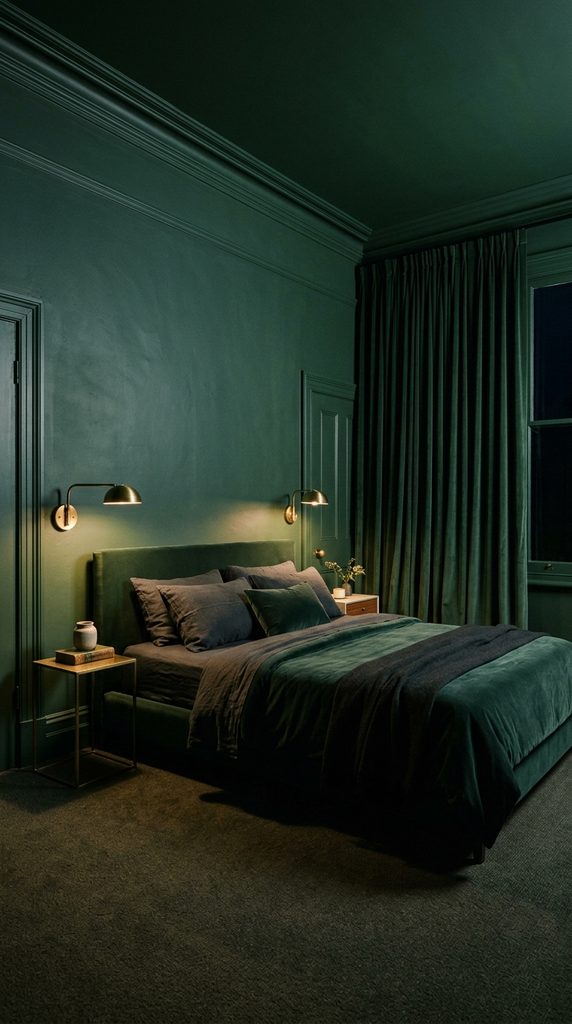
Color-drenching an entire room in a saturated, light-absorbing pine needle green dissolves hard corners and visually expands room height. Specifically, applying an ultra-matte, chalky emulsion across walls, crown molding, baseboards, and interior door casings creates a seamless architectural backdrop. Furthermore, pairing this finish with floor-to-ceiling heavyweight pine velvet drapes creates a cocoon-like sanctuary that softens acoustic echoes. As a result, the room insulates effectively against drafts while feeling remarkably grand. Consequently, standard drywall enclosures evolve into cohesive, atmospheric retreats.
Materiality and Color Story
- Dominant Paint: Matte chalk-wash emulsion in deep blackened spruce and highland pine needle.
- Textiles: 450 GSM cotton velvet drapery panels pooling softly on the floor.
- Accents: Matte-black door hardware and unlacquered, patinated brass switch plates.
Styling and Illumination
- First, install double-bracket drapery rods flush to the ceiling line, letting velvet panels fall in deep, structured pleats.
- Next, mount low-profile unlacquered brass swing-arm wall lamps fitted with 2400K warm LED filament bulbs to cast soft, directional downlight.
- In addition, layer seating with deep-pile wool rugs in complementary dark olive and slate-gray tones to ground the monochromatic scheme effectively.
2. Preserved Living Moss & Fern Niche Murals
Three-Dimensional Vertical Forest Floors
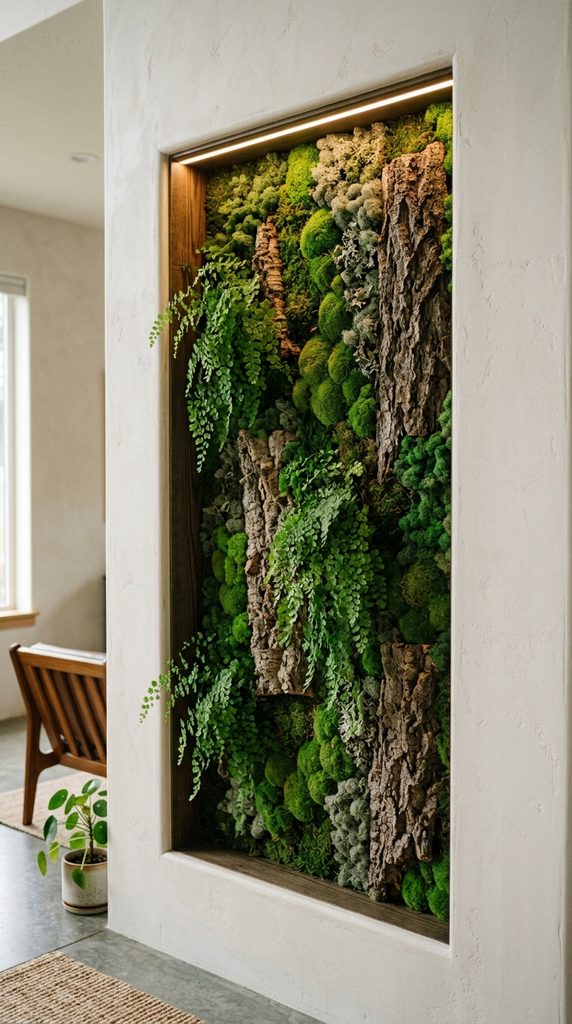
Bringing living woodland floor textures directly onto vertical interior surfaces, this concept embeds preserved botanicals into custom recessed architectural wall niches. For example, using zero-maintenance preserved reindeer moss, dark mood moss, real bark slabs, and dried maidenhair ferns creates a tactile, three-dimensional vertical garden. Moreover, this natural tapestry requires absolutely no sunlight or watering. Therefore, interior alcoves gain rich organic life without high-maintenance care routines.
Materiality and Color Story
- Botanicals: Preserved sheet moss, cushion moss, dried lichens, and real oak bark fragments.
- Framing: Recessed drywall niches trimmed in dark-stained ash or ebonized wood molding.
- Palette: Vibrant emerald, deep chartreuse, earthy soil brown, and charred wood gray.
Styling and Illumination
- First, route an invisible aluminum LED channel into the top lip of the wall recess, using a diffused 2700K strip to skim raking light downward over the moss textures.
- Meanwhile, position the botanical niche behind an executive desk or reading armchair as an organic focal point.
- Finally, introduce subtle natural cedar and pine essential-oil atomizers nearby to complete the sensory illusion of being in an ancient pine grove.
3. Charred Shou Sugi Ban & Ebonized Timber Cabinetry
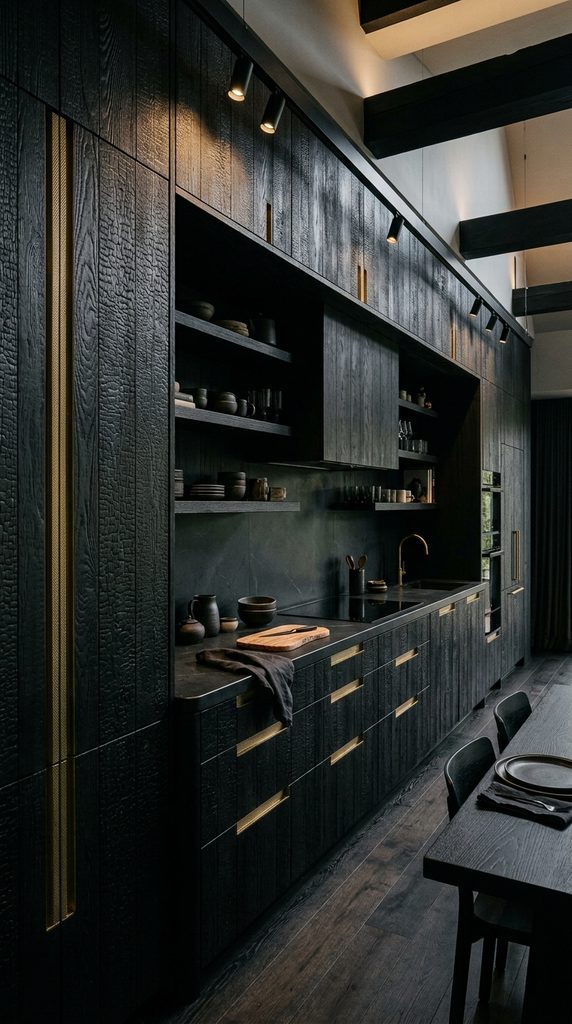
Fire-Hardened Tactile Millwork
Rooted in traditional Japanese architectural craft, Shou Sugi Ban (charred cedar) introduces deep, textured black surfaces to built-in cabinetry and accent paneling. In fact, the alligator-skin texture produced by flame treatment absorbs ambient glare with exceptional ease. As a result, this wood treatment provides a rich, velvety backdrop that highlights metallic hardware and antique oil paintings. Consequently, custom cabinetry feels deeply historic rather than mass-manufactured.
Materiality and Color Story
- Cabinetry: Heavily charred cedar or wire-brushed ebonized oak millwork with an ultra-matte protective wax finish.
- Hardware: Antiqued bronze drop pulls or knurled raw brass finger tabs.
- Palette: Deep carbon black, oxidized espresso, and burnished gold.
Styling and Illumination
- First, incorporate low-glare, magnetic track spotlights into the ceiling to graze the charred wood grain at sharp 30-degree angles.
- Additionally, line internal cabinet display bays with warm walnut or dark sage green backings to provide subtle contrast for displayed glassware.
- Subsequently, pair charred cabinetry with honed black granite or soapstone countertops featuring soft, rounded bullnose edges.
4. Glowing Sculptural Fungal & Mushroom Lamps
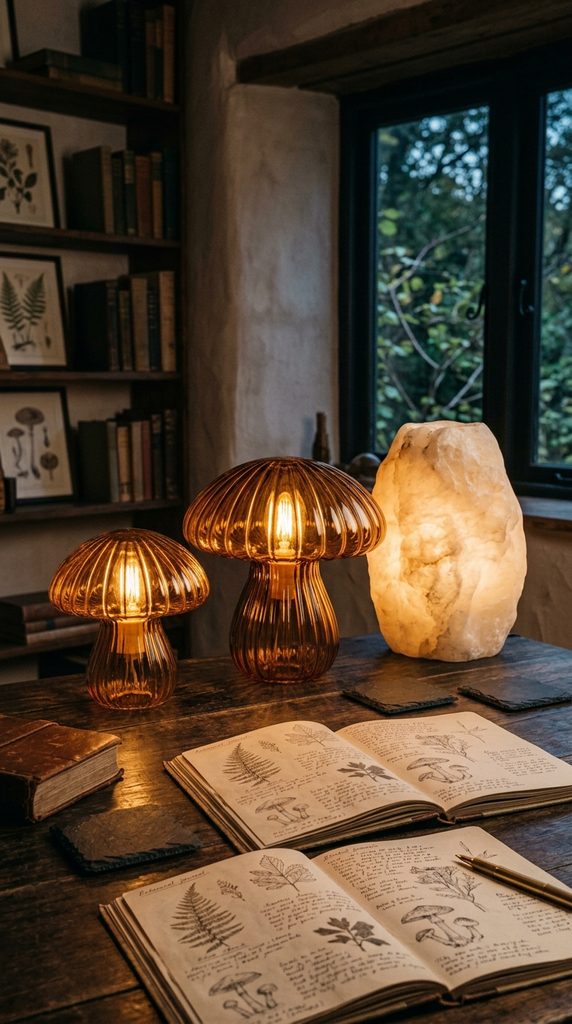
Organic Biological Glassware
Sculptural lighting inspired by woodland fungi serves as functional biological art. For instance, hand-blown fluted amber glass, carved alabaster, or 3D-printed bio-resins create mushroom caps and stems that cast warm, diffuse light across nightstands, consoles, and deep window sills. Thus, whimsical forest floor elements find sophisticated expression within modern homes.
Materiality and Color Story
- Lamp Base & Shade: Hand-blown fluted amber glass, veined alabaster stone, or textured matte ceramic.
- Internal Light: Warm 2200K ambient LED fixtures or low-wattage vintage amber spiral filaments.
- Palette: Translucent honey amber, cloudy alabaster, chanterelle ochre, and warm bronze.
Styling and Illumination
- Initially, group mushroom lamps in asymmetrical clusters of two or three at varying heights on low wooden side tables.
- Furthermore, keep the ambient light level intentionally low, using the mushroom lamps to provide soft, localized accent pools rather than room-filling brightness.
- Afterward, place a lamp beside a stack of vintage botanical journals or a rough-hewn stone tray to balance modern lighting with historic curio styling.
5. Moody English Countryside Panoramic Forest Murals
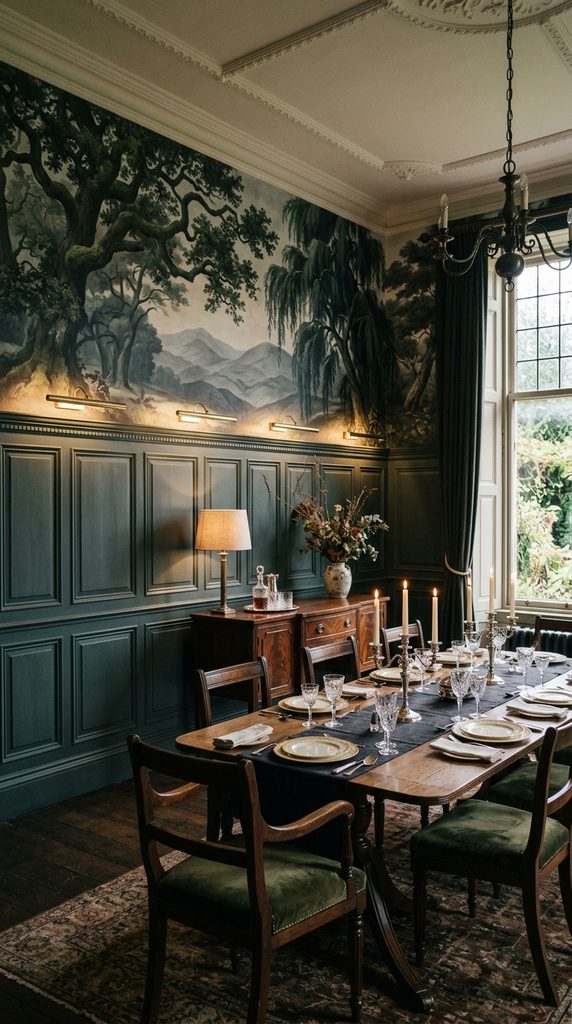
Mist-Veiled Pastoral Landscapes
Transforming flat drywall into an expansive, misty woodland glade, custom panoramic wallpaper murals introduce historic storybook depth to living rooms and formal dining areas. Specifically, high-end modern murals feature shadowy, hand-painted renderings of ancient oaks, weeping willows, meandering deer, and distant foggy ridgelines in muted slate, charcoal, and forest green. Consequently, your walls visually open up to reveal an enchanting, distant wilderness.
Materiality and Color Story
- Wallcovering: Heavyweight, fibrous non-woven wallpaper substrate with a subtle matte canvas-weave texture.
- Palette: Misty sage, charcoal-green, deep woodland pine, and aged parchment cream.
- Trim Coordination: Baseboards, wainscoting, and door architraves painted in deep spruce to frame the landscape.
Styling and Illumination
- To begin, install traditional picture-frame molding or beadboard wainscoting along the lower third of the wall, mounting the mural above to mimic historic manor wall art.
- Next, hang slim, unlacquered brass library picture lights centered directly above primary mural panels to illuminate the scenic vista.
- Finally, pair the wallpaper with traditional English roll-arm seating or antique wingback chairs upholstered in textured tweed or boucle.
6. Apothecary Amber Glass & Dried Herbarium Vignettes
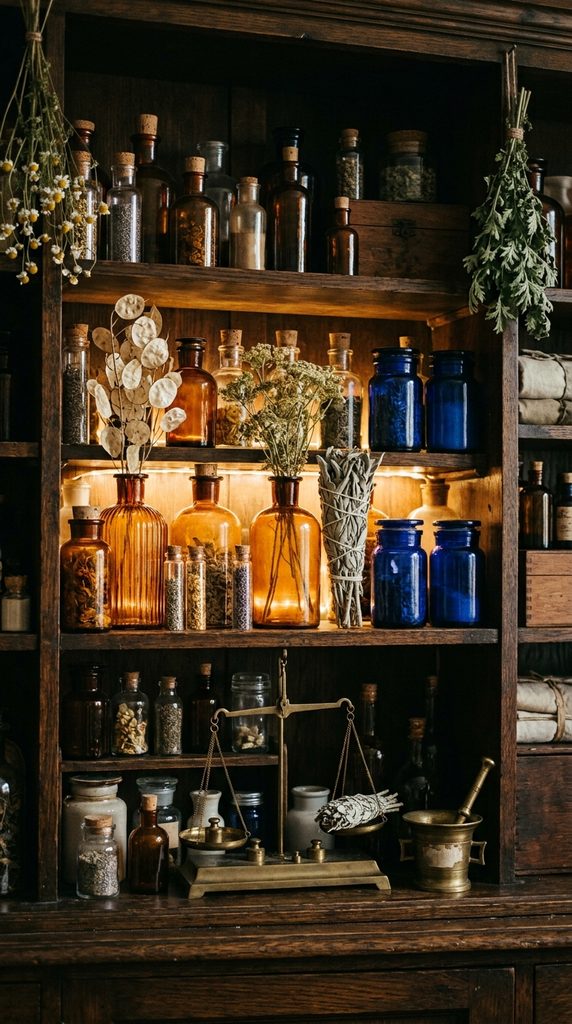
Historic Herbalist Workshop Styling
Channeling the aesthetic of a 19th-century botanical apothecary, open shelving and floating consoles are styled with curated collections of vintage amber and cobalt glass bottles. In particular, these vessels hold dried honesty seed pods, skeletal eucalyptus branches, wild hemlock, and bundles of fragrant dried sage tied with natural jute twine. Therefore, domestic storage surfaces evoke the scholarly charm of an ancient herbarium.
Materiality and Color Story
- Vessels: Ribbed and smooth antique apothecary bottles, glass reagent jars with ground-glass stoppers, and corked vials.
- Botanicals: Dried poppy seed heads, honesty pods (Lunaria), dark lavender stems, and preserved ferns.
- Palette: Rich warm amber, cobalt blue, apothecary brown, and dried parchment.
Styling and Illumination
- First, route concealed micro-LED light channels under shelf lips to backlight the amber glassware from behind, creating a warm, stained-glass glow.
- In addition, label bottles with aged parchment tags featuring hand-calligraphed botanical Latin names in faded black ink.
- Afterward, style the display alongside antique brass weighing scales, brass magnifying glasses, and mortar-and-pestle sets.
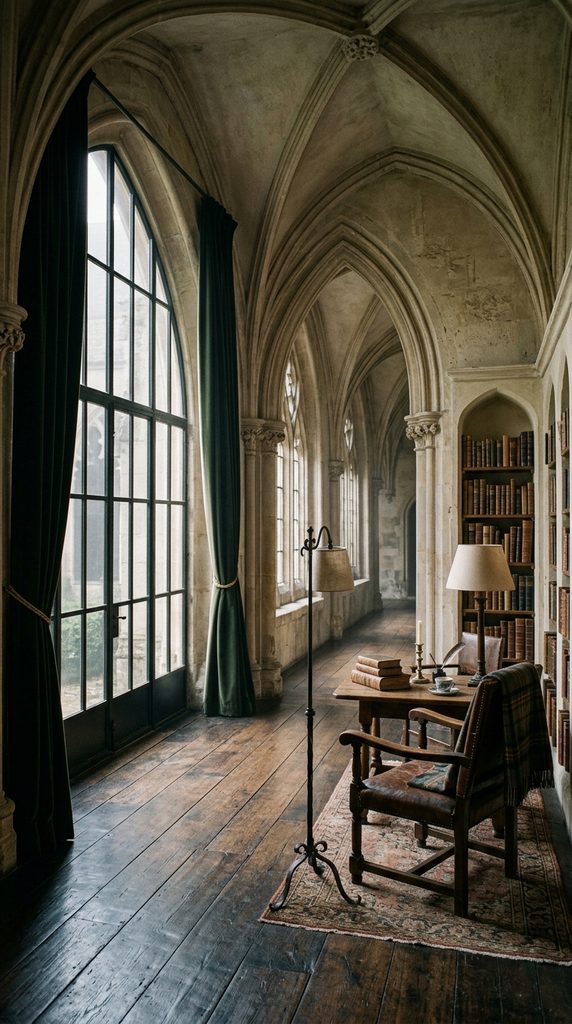
7. Raw Cleft-Face Slate & Basalt Monolithic Fireplaces
Primal Stone Anchors
Replacing polished marble mantels with monolithic slabs of rough-cleft slate or volcanic basalt grounds the living room with earth-born power. Indeed, the irregular, tactile stone face mimics towering forest boulders. Furthermore, it catches the dancing flames of a log fire with dramatic shadow play. Hence, the fireplace transforms into a primeval gathering hearth.
Materiality and Color Story
- Stone Mantel: Hand-split cleft-face slate slabs or volcanic basalt panels with natural chiseled edges.
- Hearth Details: Heavy blackened steel fire screens, forged iron tool sets, and stacked natural birch logs.
- Palette: Wet-river slate gray, deep charcoal, graphite, and ash black.
Styling and Illumination
- First, run the cleft-face stone all the way to the ceiling crown to emphasize vertical architectural scale.
- Meanwhile, install floor-recessed narrow-beam spotlights at the base of the stone to cast dramatic uplighting across the textured fissures.
- Ultimately, keep the hearth styled simply with an oversized matte-black iron log basket holding unpeeled birch logs and kindling.
8. Gothic Cloister Arches & Blackened Steel Mullions
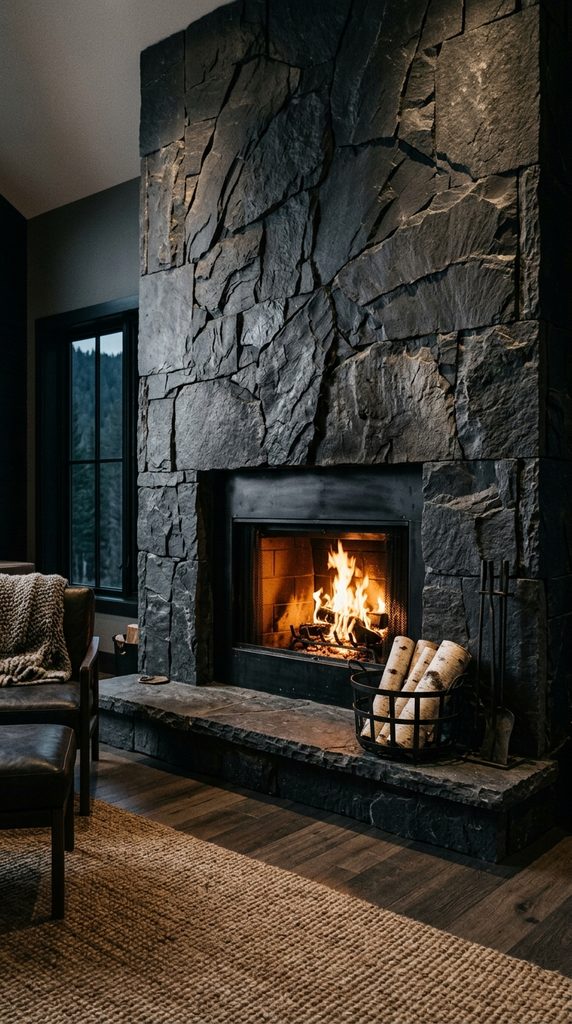
Monastic Historic Architectural Detailing
Architectural millwork takes a dramatic cue from historic European cloisters. For example, pointed arch doorways, recessed plaster niches, and floor-to-ceiling window panes framed in blackened steel bring soaring historic gravitas to contemporary interiors. In doing so, these architectural features frame exterior gardens like stained-glass artworks.
Materiality and Color Story
- Doors & Windows: Custom blackened steel window frames with narrow T-bar glazing mullions.
- Wall Niches: Smooth hand-applied lime-plaster pointed gothic arches built into drywall partitions.
- Palette: Weathered limestone, matte black iron, and deep woodland green.
Styling and Illumination
- Initially, use pointed gothic arch niches to frame built-in bookshelves, displaying vintage hardcovers and curios.
- Furthermore, allow natural morning daylight to filter through narrow steel window mullions, casting geometric shadows across hardwood floors.
- Additionally, hang heavy velvet portiere curtains inside arched doorways to provide acoustic insulation and visual drama.
9. Twisting Forged-Iron Tree Canopy Chandeliers
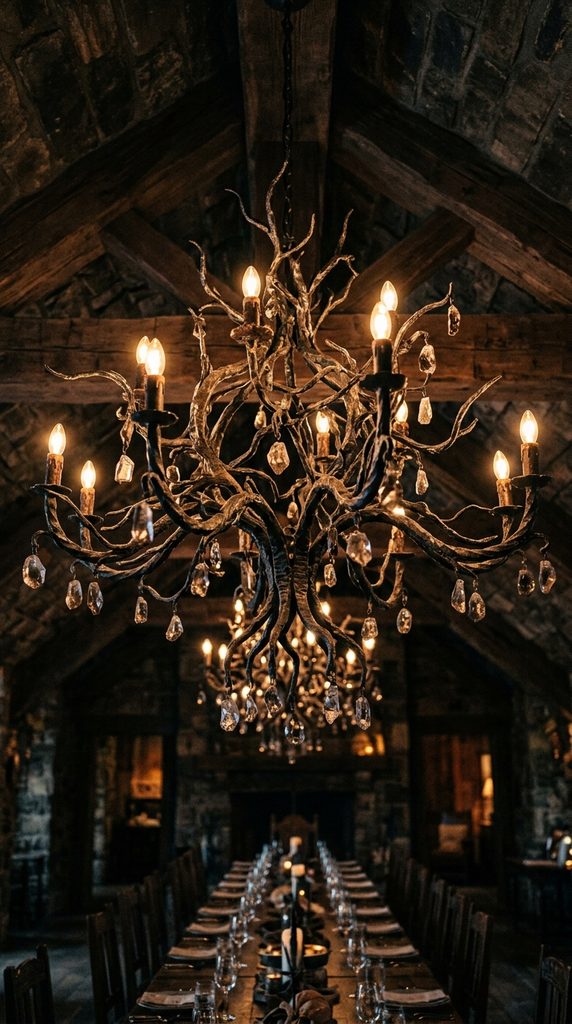
Hand-Hammered Ceiling Sculptures
Lighting fixtures become sculptural, blacksmith-crafted branch networks that mimic tangled forest canopies. Specifically, custom chandeliers crafted from hand-forged wrought iron branch outward across the ceiling. Moreover, they are tipped with flickering LED candle sleeves or delicate blown-glass dewdrop crystals that shimmer in evening drafts. As a consequence, overhead fixtures double as majestic botanical art pieces.
Materiality and Color Story
- Metalwork: Hand-forged wrought iron with hammered bark-like textures and an oxidized beeswax finish.
- Pendants: Hand-blown clear glass dewdrop crystals or raw smoky quartz crystal points.
- Palette: Matte blacksmith black, dark verdigris bronze, and clear crystal highlights.
Styling and Illumination
- To begin with, suspend the branch chandelier centrally over a large dining table or in a double-height entryway to serve as the primary artistic anchor.
- Next, fit the fixture with candelabra-base bulbs tuned to 2200K–2400K on an architectural slider dimmer to mimic real candlelight.
- Finally, allow the hand-hammered iron branches to extend organically toward the corners of the ceiling, casting textured twig shadows overhead.
10. Victorian Specimen Entomology & Coleoptera Shadowboxes
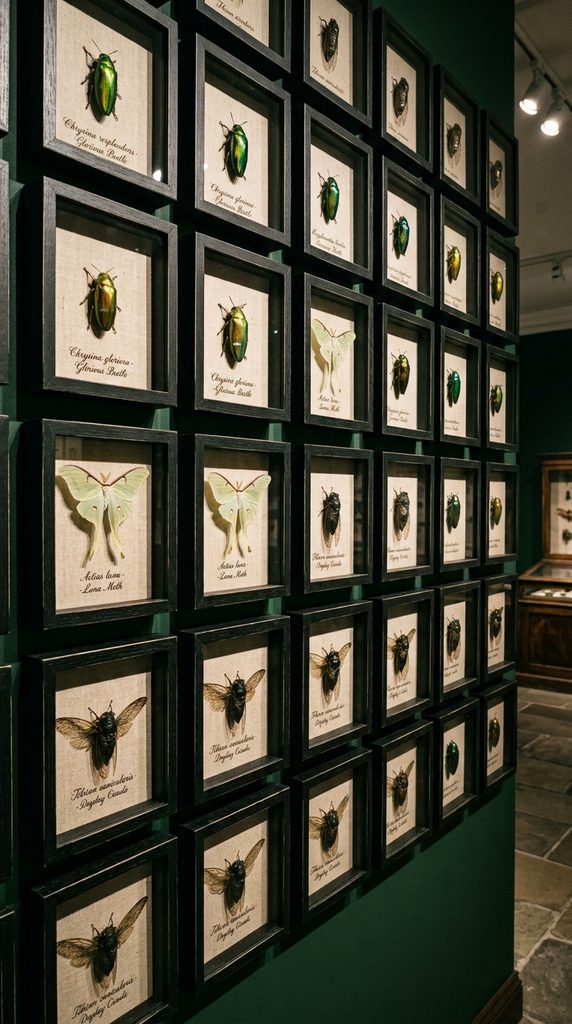
Iridescent Natural History Art
Embracing Victorian curiosity cabinets, gallery walls are curated with museum-grade, ethically sourced insect and butterfly specimens. In particular, metallic jewel beetles, giant luna moths, and forest cicadas pinned on antique cream linen mats add iridescent green and bronze accents against dark-painted walls. Thus, science and high-end aesthetics meet in striking harmony.
Materiality and Color Story
- Frames: Deep-set wooden shadowbox frames finished in distressed matte black or antique gold leaf.
- Mats: Coarse, unbleached linen or heavy deckle-edge watercolor paper.
- Palette: Iridescent emerald beetle-green, burnished copper, velvety black, and antique ivory.
Styling and Illumination
- First, arrange shadowboxes in disciplined geometric grids of six, eight, or twelve frames across an accent wall for a scholarly aesthetic.
- Concurrently, mount narrow 15-degree ceiling spotlights focused directly on individual glass frame faces to make the metallic wings shimmer.
- In addition, include hand-written taxonomic labels beneath each specimen with species names and collection dates in calligraphy.
11. Distressed Cigar-Leather & Truffle Tufted Chesterfields
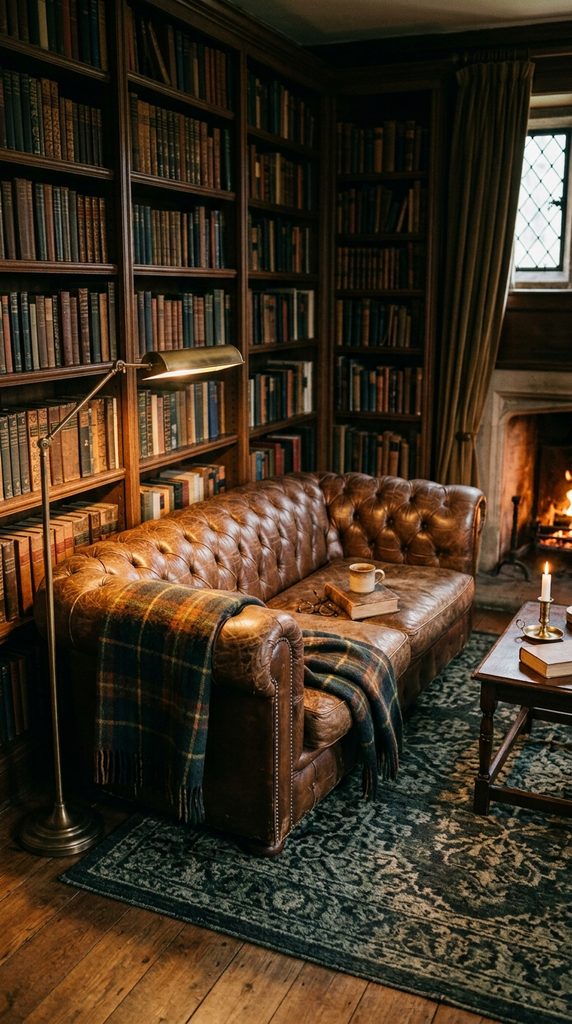
Heirloom Seating with Weathered Character
Every dark forest sanctuary requires a substantial, welcoming seating anchor. For instance, deeply tufted Chesterfield sofas upholstered in vegetable-tanned, crackled cigar-brown or deep truffle leather provide welcoming comfort. Over time, the leather patinates gracefully like ancient tree trunks. Consequently, the seating invites slow evenings spent reading by the fire.
Materiality and Color Story
- Upholstery: Full-grain, pull-up aniline leather with natural surface variations, scuffs, and crackled patina.
- Frame: Solid hardwood construction with deep diamond button tufting and antiqued brass upholstery tacks.
- Palette: Rich cigar brown, deep espresso truffle, and warm cognac undertones.
Styling and Illumination
- First, pair the sofa with an adjacent brass pharmacy floor lamp with a dark green glass or metal shade for late-night reading.
- Next, drape the leather backrest with a heavy, brushed alpaca wool throw in deep forest green or charcoal tartan.
- Afterward, flank the seating with dark walnut side tables holding natural stone coasters and an amber glass decanter.
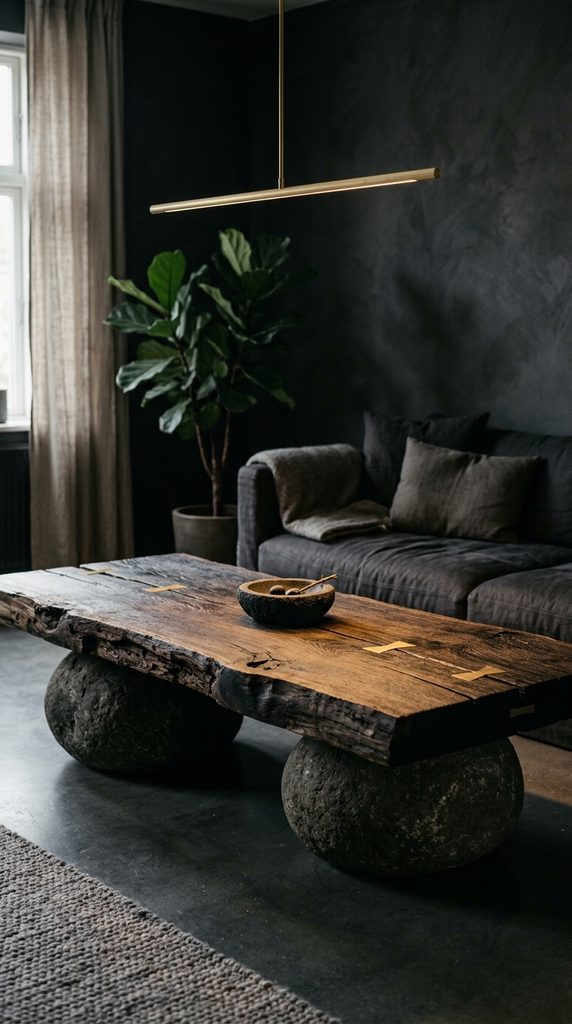
12. Floating Live-Edge Bog Oak & River-Stone Tables
Sculptural Woodland Carpentry
Furniture pieces celebrate the irregular, natural contours of ancient trees and riverbeds. In particular, coffee tables and dining surfaces crafted from thick, live-edge English walnut or petrified bog oak rest on smoothed river-stone plinths. This design preserves natural bark pockets, cracks, and sapwood transitions. Hence, each furniture piece stands as a unique tribute to ancient wilderness.
Materiality and Color Story
- Tabletop: Multi-inch thick live-edge slab of dark bog oak or walnut finished with a natural hard-wax oil.
- Base: Custom-carved hollowed basalt river boulders or matte-black blackened steel pedestals.
- Palette: Deep chocolate walnut sapwood, river-stone charcoal, and brass bowtie butterfly keys.
Styling and Illumination
- Initially, position a low-profile, multi-pendant linear chandelier directly over the center of the live-edge slab to highlight the natural wood grain.
- Furthermore, stabilize organic drying checks in the timber using visible butterfly keys crafted from unlacquered brushed brass.
- Ultimately, keep tabletop decor minimal: a single carved volcanic stone bowl holding smooth river stones or dried moss balls.
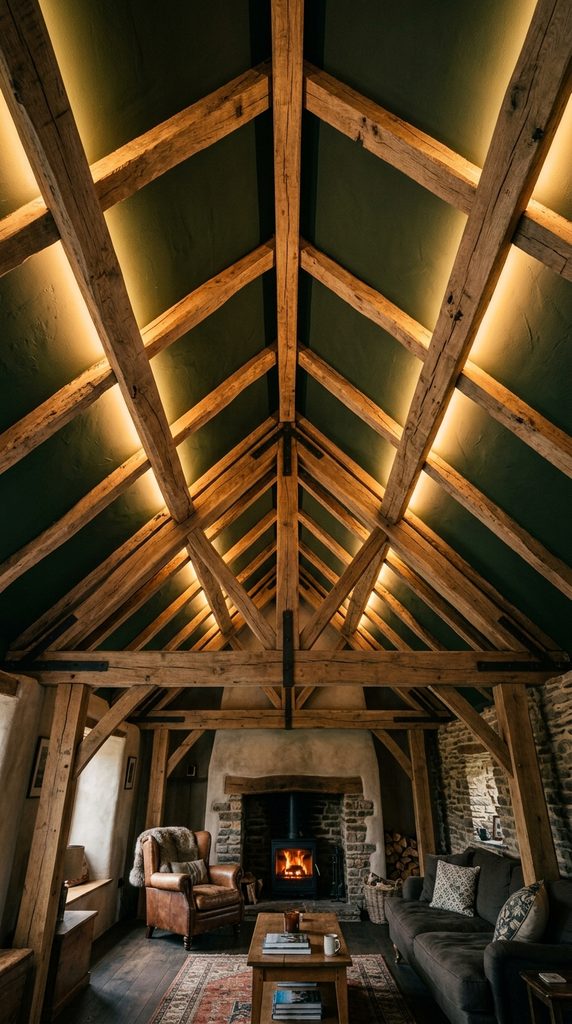
13. Deep Forest Green Ceilings with Heavy Timber Rafters
Inverted Canopy Architecture
Reversing standard white ceiling rules, this trend coats ceilings in rich, dark moss or ink-green tones, intersected by rough-hewn timber rafters. Consequently, this technique creates a sheltered, subterranean canopy effect. As a result, it draws the eye downward toward low-level seating and conversation zones. Thus, high-ceilinged rooms immediately gain cozy intimacy.
Materiality and Color Story
- Ceiling Plane: Matte interior ceiling paint in deep cypress green or blackened moss.
- Structural Beams: Reclaimed, hand-hewn white-oak or Douglas fir timber beams with visible adze marks and iron strap plates.
- Palette: Canopy cypress green, weathered dark oak, and matte iron black.
Styling and Illumination
- First, conceal low-voltage LED uplight ribbons along the upper top edges of the timber beams, washing indirect warm light across the dark ceiling plane.
- Meanwhile, keep wall treatments slightly lighter in tone to create an authentic visual transition resembling forest foliage overhead.
- Finally, install a central ceiling pendant with a wide, shallow dark metal dome to cast warm pools of light downward.
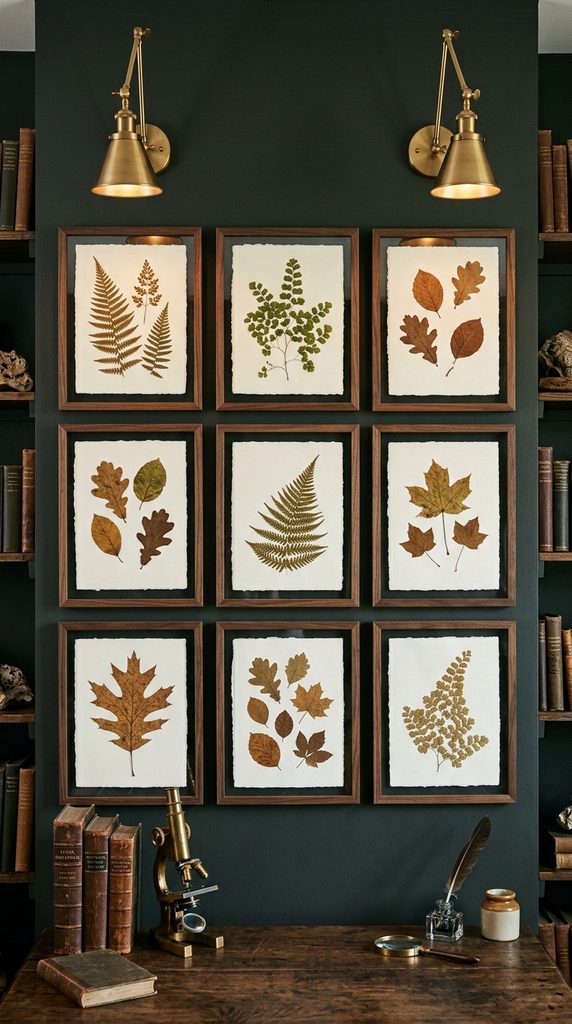
14. Framed Vintage Herbarium & Fern Pressing Grids
Academic Botanical Wall Displays
Bringing academic botanical history to life, series of pressed botanical specimens are mounted under float-glass frames. Specifically, skeletons of autumn fern fronds, wild woodland violets, and lichen-crusted twigs mounted on deckle-edged watercolor paper create an organized, scholarly gallery display. Therefore, vertical walls reflect a lifelong passion for natural exploration.
Materiality and Color Story
- Paper & Frames: Heavy 300 GSM deckle-edged cotton rag paper framed in thin, aged dark walnut or antique gilt moldings.
- Specimens: Real pressed botanical foliage: bracken ferns, maidenhair, oak leaves, and forest mosses.
- Palette: Dried olive green, russet ochre, faded sepia, and warm cream.
Styling and Illumination
- To start, hang the frames in a tight, disciplined 3×3 or 4×3 grid on an accent wall painted in deep matte charcoal or dark spruce.
- Next, use museum-grade anti-reflective UV-filtering glass to protect delicate organic specimens from fading.
- Afterward, illuminate the entire gallery grid with a pair of matching brass articulating picture sconces mounted overhead.
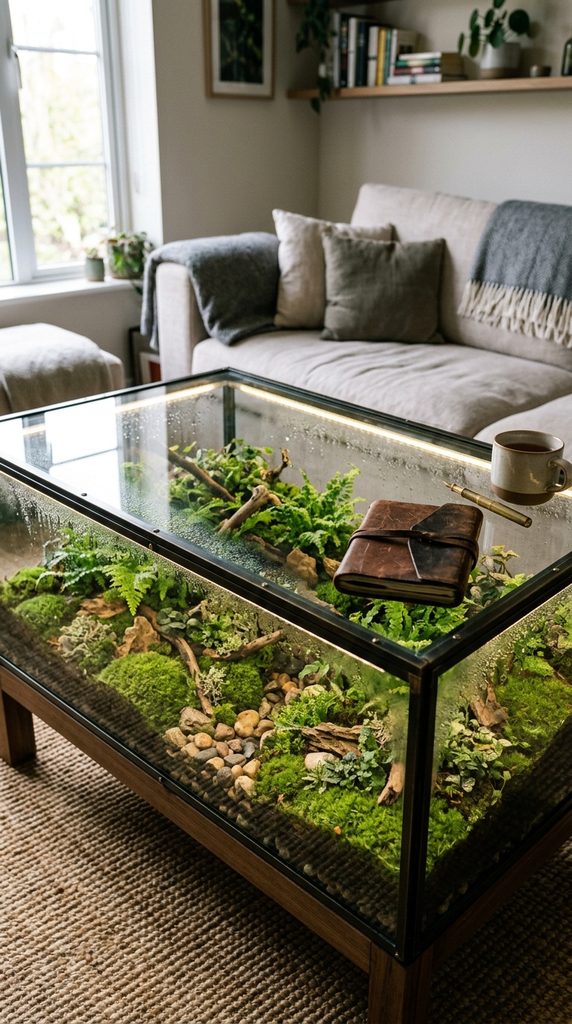
15. Enchanted Woodland Floor Terrarium Vitrines
Sealed Living Micro-Ecosystems
Transforming the coffee table or console into a living, sealed micro-ecosystem, heavy glass-topped display vitrines house thriving miniature forest habitats. Inside the climate-controlled glass vitrine, slow-growing ferns, river pebbles, cushion moss, and miniature quartz clusters thrive beneath low-profile LED grow lights. Thus, an entire living forest floor thrives safely indoors.
Materiality and Color Story
- Vitrine Enclosure: Heavy tempered glass display case with sealed black anodized aluminum or brass framing.
- Internal Flora: Cushion moss (Leucobryum glaucum), miniature tropical ferns, lichens, and slate gravel.
- Palette: Vivarium emerald, damp potting soil black, river-stone gray, and clear quartz.
Styling and Illumination
- First, integrate hidden, high-CRI full-spectrum micro-LED grow strips inside the upper metal frame to keep botanicals healthy while acting as an ambient light source.
- In addition, keep the glass completely clear of fingerprints using micro-fiber cloths and distilled water spray.
- Finally, surround the exterior vitrine with dark-stained wood consoles or leather-bound field journals.
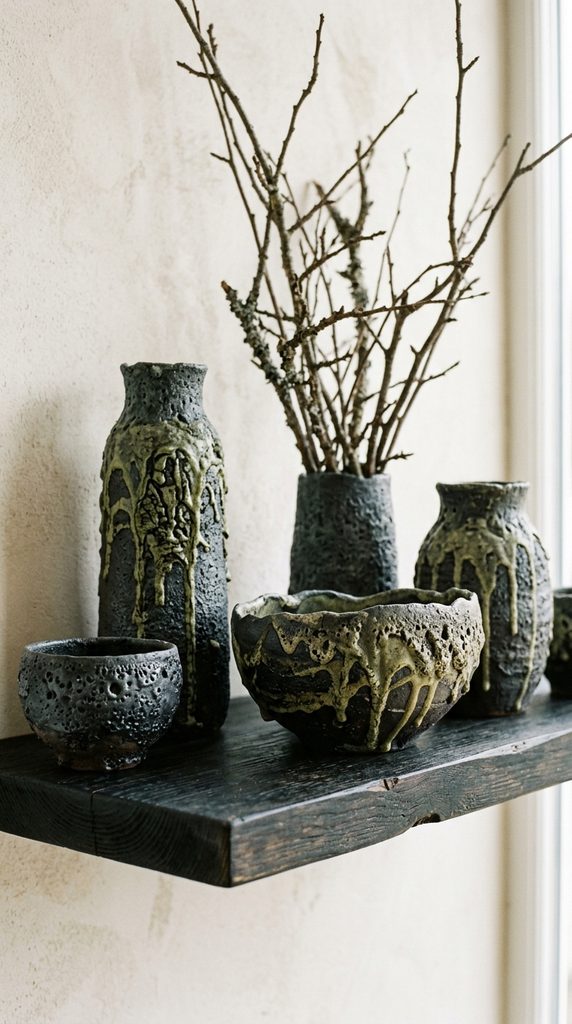
16. Volcanic Ash & Bark-Textured Artisanal Stoneware
Tactile Functional Pottery
Tabletop styling embraces tactile, irregular pottery reminiscent of tree bark and rain-soaked earth. For example, stoneware vessels finished with textured volcanic ash glazes, crackle stoneware, and dark metallic iron slips bring organic, functional beauty to open shelves and kitchen displays. As a result, even utilitarian containers reflect the wild outdoors.
Materiality and Color Story
- Clay Body: Coarse dark stoneware or iron-rich black clay with visible grog and sand texture.
- Glazes: High-fire volcanic ash crater glazes, matte charcoal crawl glazes, and dripping lichen-green slips.
- Palette: Volcanic matte black, rain-soaked bark brown, textured charcoal ash, and lichen olive.
Styling and Illumination
- Initially, display functional pitchers, bowls, and tall branch vases openly on thick floating oak shelves.
- Moreover, allow natural raking daylight from adjacent windows to highlight the irregular cratered surfaces of the pottery.
- In the meantime, fill tall ceramic vessels with sculptural, bare winter branches, dried pussy willow stems, or thorny brambles.
17. Deep Damson Plum & Blackberry Silk Velvet Accents
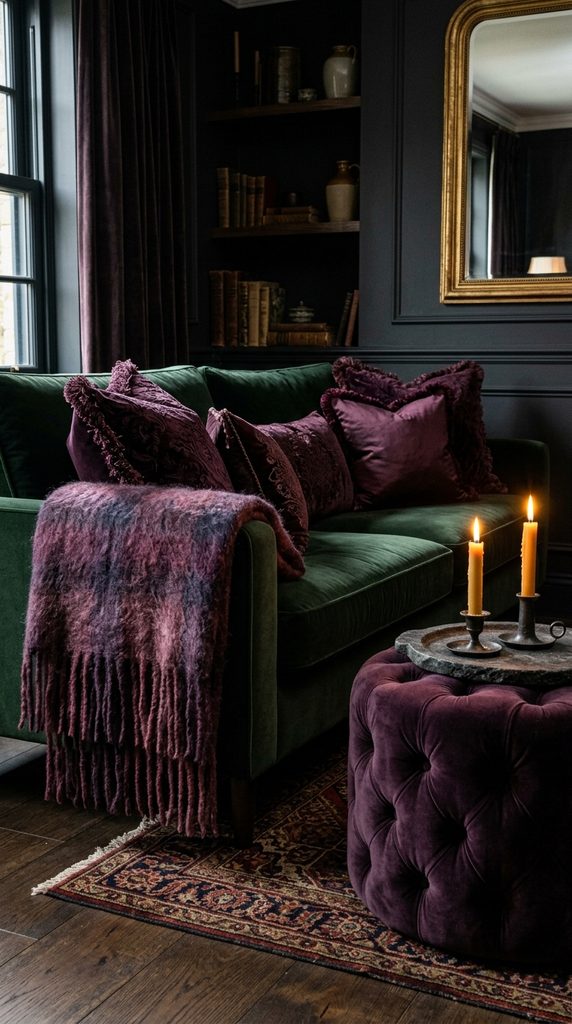
Rich Jewel-Tone Contrast
Introducing rich berry tones into deep green schemes prevents monochromatic forest spaces from feeling one-dimensional. In particular, accent cushions, mohair throws, and upholstered ottomans in deep blackberry, black-cherry, and damson wine add rich contrast to dark green furniture. Consequently, the room acquires luxurious depth and warmth.
Materiality and Color Story
- Textiles: Heavy silk-viscose velvet, brushed kid mohair throws with twisted fringe, and woven wool jacquard cushions.
- Palette: Bruised blackberry, dark damson plum, black currant, and deep wine.
- Base Contrast: Set against deep pine green, charred wood, or dark slate gray upholstery.
Styling and Illumination
- First, place a pair of oversized damson velvet pillows at the corners of a dark green sofa, flanking a central textured wool cushion.
- Additionally, use a round tufted velvet footstool in deep blackberry as an accent piece in a reading corner.
- Finally, allow the shifting sheen of the silk velvet pile to catch ambient candlelight, creating dynamic, wine-colored highlights.
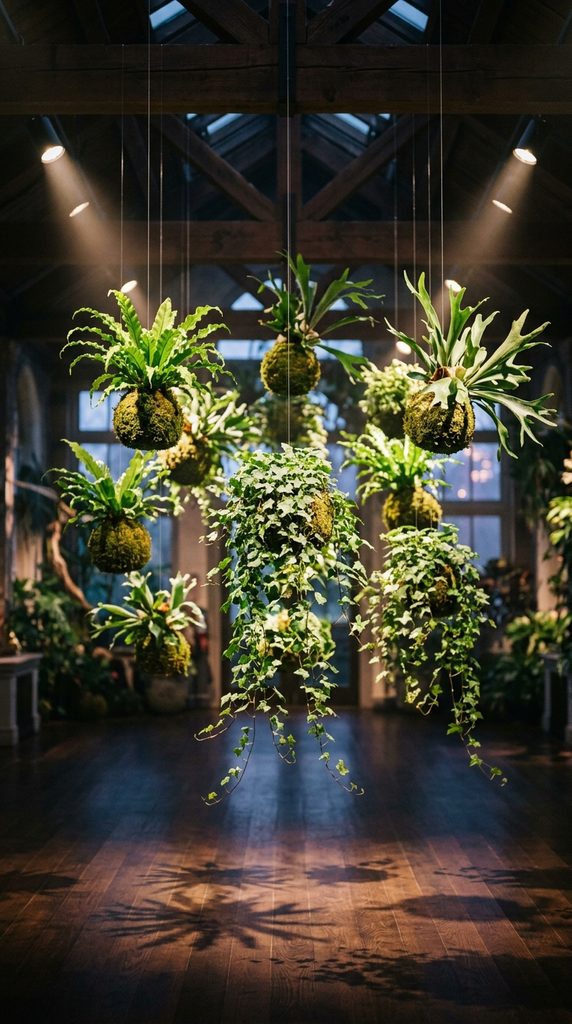
18. Suspended Botanical Kokedama & Lichen Canopies
Aerial Greenery Installations
Elevating greenery into dynamic aerial sculptures, the Japanese art of kokedama suspends moss-wrapped root balls from the ceiling with transparent lines or dark jute cords. Furthermore, trailing ivy, bird’s nest ferns, and staghorn ferns dangle at staggered heights. In turn, they create a floating green canopy overhead.
Materiality and Color Story
- Installations: Sphagnum moss root balls bound with waxed black twine or monofilament hanging wire.
- Plant Varieties: Asplenium ferns, weeping string-of-hearts, trailing English ivy, and staghorn ferns.
- Palette: Lush sphagnum green, dark jute brown, and cascading leafy emerald.
Styling and Illumination
- To begin, hang kokedama balls in staggered vertical groupings of three or five above a dining table or in a well-lit reading corner.
- Next, angle narrow-beam ceiling pin-spots downward to catch the trailing foliage, casting delicate leaf shadows on the surfaces below.
- Subsequently, mist the moss spheres regularly with rainwater from a vintage brass mister kept on a nearby display tray.
19. Antiqued Foxed Mirrors with Verdigris & Faux Mossing
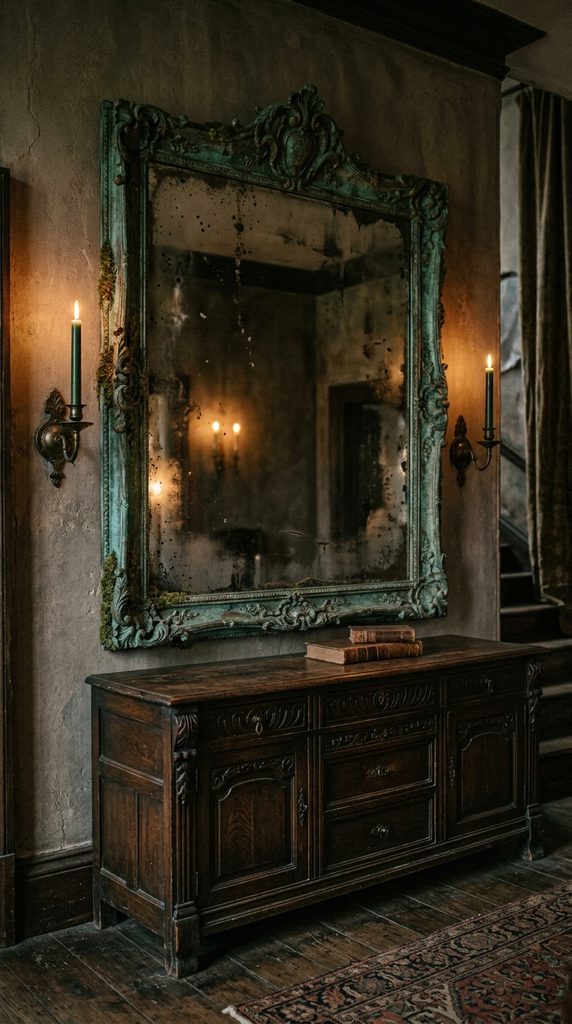
Weathered Light Multiplication
Reflective surfaces are reimagined with aged, distressed finishes that mimic antique glass weathered by decades in a damp conservatory. Specifically, antiqued mirrors featuring heavy charcoal oxidation, faux mossing along edges, and patinated bronze frames bounce ambient candlelight softly without creating stark modern reflections. Hence, ambient illumination multiplies with gentle subtlety.
Materiality and Color Story
- Mirror Glass: 6mm silver-backed mirror treated with acid etching, deep perimeter foxing, and charcoal clouding.
- Frame: Ornate cast resin or wood finished in oxidized verdigris bronze with subtle dark green patination.
- Palette: Distressed mercury silver, oxidized verdigris, antique bronze, and smoky charcoal.
Styling and Illumination
- First, mount an oversized antiqued mirror directly above a living room fireplace mantel or dining room sideboard.
- Next, flank the mirror with a pair of wall-mounted candle sconces holding tall, fluted dark green or charcoal beeswax tapers.
- Ultimately, the distressed glass softens harsh glare, reflecting the warm, flickering flames with atmospheric depth.
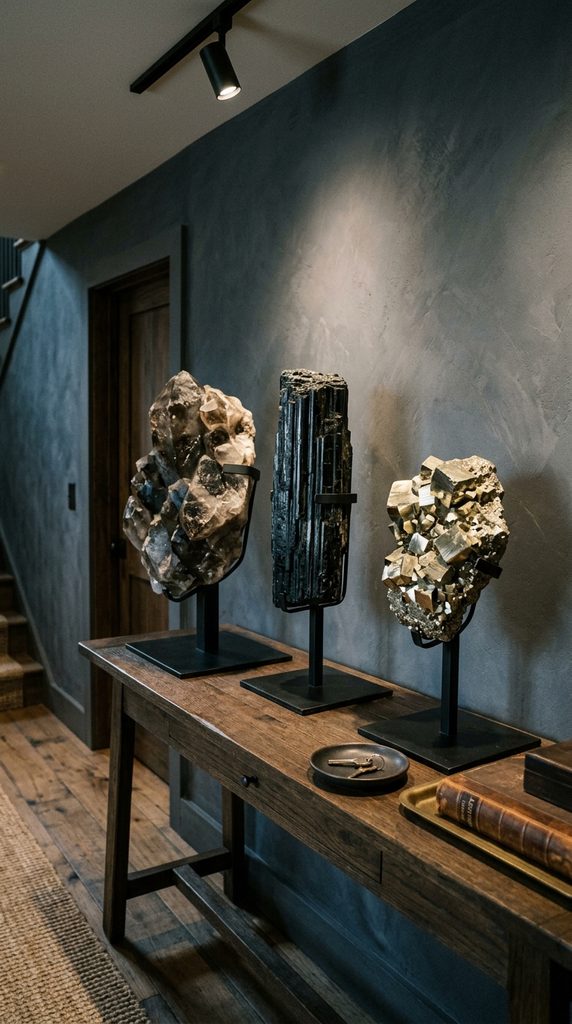
20. Raw Smoky Quartz & Black Tourmaline Specimen Consoles
Subterranean Geologic Geometry
Bringing raw subterranean geology to bookshelves and credenzas, massive clusters of natural smoky quartz, raw black tourmaline, and pyrite are displayed on minimal iron stands. Indeed, the geometric, crystalline facets introduce a sparkling, primeval element that contrasts with soft mosses and fabrics. Therefore, ancient geology anchors modern carpentry.
Materiality and Color Story
- Minerals: Unpolished, raw mineral clusters: smoky quartz points, striated black tourmaline pillars, and metallic brassy pyrite cubes.
- Stands: Custom minimalist black steel museum-mount armatures with flat square bases.
- Palette: Translucent smoky tea-gray, deep obsidian black, and metallic brass.
Styling and Illumination
- Initially, position mineral specimens on open floating shelves or entryway consoles beside collections of antique leather-bound books.
- Furthermore, direct a focused, low-voltage LED spotlight to graze the natural crystal terminations, highlighting internal fractures and light refraction.
- Afterward, pair mineral clusters with smooth, tumbled river stones and small brass dishes for varied geometric interest.
21. Forest Floor Scent-Scaping (Pine, Cedar, & Wet Petrichor)
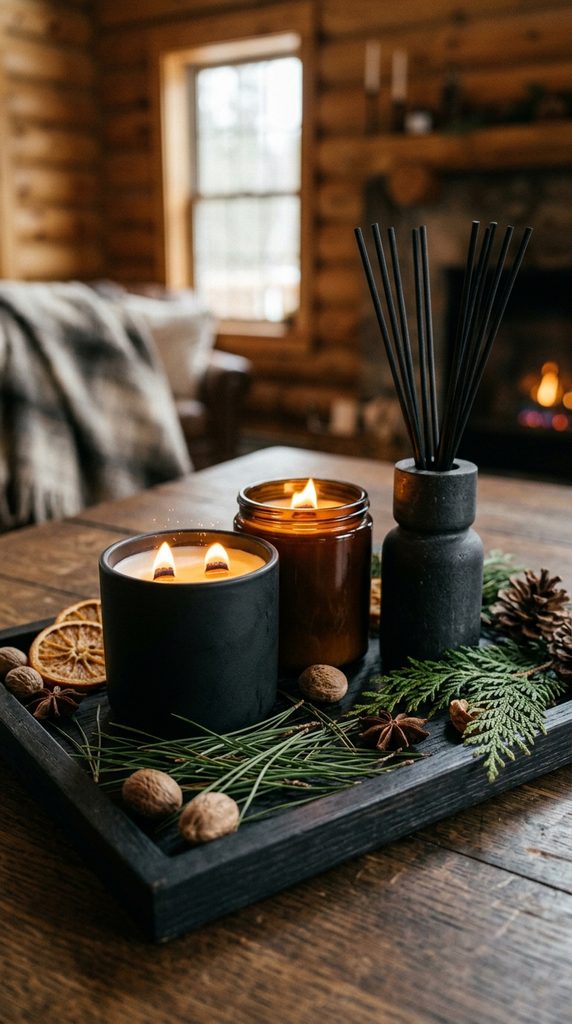
Multi-Sensory Atmospheric Immersion
True interior design engages all the senses. Specifically, the Dark Forest aesthetic relies on deliberate olfactory scent-scaping using authentic natural resin diffusers, soy candles, and room sprays. For example, notes of Siberian fir, charred cedarwood, smoky vetiver, damp petrichor, and oakmoss immerse visitors the moment they enter. As a result, the atmospheric illusion becomes completely undeniable.
Materiality and Color Story
- Containers: Matte-black ceramic vessels, heavy dark amber glass tumblers, and turned stone diffuser pots.
- Ingredients: 100% natural soy and beeswax bases, essential oils of pinene, cedarwood, vetiver, and oakmoss.
- Palette: Creamy natural wax, dark charcoal pottery, and natural rattan reeds.
Styling and Illumination
- First, place double-wick botanical candles on stone coasters on coffee tables, mantels, and bedside tables.
- Next, keep wooden matchboxes with dark green match heads beside every candle for a tailored styling detail.
- Finally, light candles twenty minutes before entertaining guests to allow deep, woodsy base notes to saturate the room subtly.
Dark Forest Material & Color Coordination Matrix
| Design Trend | Dominant Color Story | Key Tactile Material | Primary Lighting Method | Spatial Impact |
| Pine Velvet Drenching | Deep Pine & Blackened Spruce | Matte Cotton Velvet | Articulating Brass Sconces | Enveloping Intimacy & Height |
| Preserved Moss Walls | Emerald & Charcoal Bark | Living Preserved Moss | Concealed Grazing LED Strip | Vertical Natural Tapestry |
| Shou Sugi Ban Millwork | Carbon Black & Espresso | Charred Cedar Grain | Low-Glare Track Spotlights | Rich Architectural Shadow |
| Fungal Mushroom Lamps | Translucent Amber & Ochre | Hand-Blown Fluted Glass | Internal 2200K Warm Filament | Cozy Low-Horizon Accent |
| Woodland Scenic Murals | Misty Sage & Charcoal | Textured Fibrous Paper | Unlacquered Picture Lights | Expansive Pastoral Depth |
| Apothecary Amber Glass | Warm Amber & Cobalt Blue | Blown Glass & Dried Flora | Integrated Under-Shelf LEDs | Scholarly Curiosity Accent |
| Raw Basalt Fireplace | Slate Gray & Graphite | Chiseled Cleft Stone | Dancing Real Hearth Flames | Primal Structural Anchor |
| Cathedral Arched Panes | Black Iron & Limestone | Forged Steel & Glass | Morning Filtering Daylight | Soaring Historic Grandeur |
| Branch Chandeliers | Forged Iron & Bronze | Hand-Hammered Metalwork | Candelabra LED Sleeves | Sculptural Ceiling Canopy |
| Entomology Shadowboxes | Beetle Green & Aged Gold | Metallic Insect Carapace | Narrow Focus Ceiling Spots | High-Contrast Scientific Charm |
| Tufted Leather Couch | Aged Cigar & Truffle | Full-Grain Worn Leather | Pharmacy Reading Floor Lamp | Grounded Heirloom Comfort |
| Live-Edge Stone Tables | Chocolate Walnut & Basalt | Raw Timber & River Stone | Low-Hanging Linear Pendants | Organic Natural Sculpture |
| Forest Green Ceilings | Canopy Green & Dark Oak | Ax-Hewn Wood Rafters | Concealed Beam Uplights | Subterranean Cave Comfort |
| Pressed Herbarium Frames | Dried Olive & Paper Cream | Deckle-Edge Botanical Art | Linear Picture Sconces | Curated Academic Order |
| Terrarium Vitrine Table | Vivarium Emerald & Quartz | Tempered Glass & Soil | Internal Micro-Grow LEDs | Living Central Microcosm |
| Volcanic Bark Ceramics | Matte Black & Charcoal Ash | Pitted Stoneware Clay | Raking Natural Daylight | Rustic Earthy Functionalism |
| Damson Velvet Throws | Blackberry & Plum Wine | Shimmering Silk Velvet | Flickering Beeswax Candles | Rich Jewel-Tone Contrast |
| Hanging Kokedama | Sphagnum Green & Jute | Moss Root Balls & Twine | Angled Ceiling Pin-Spots | Floating Aerial Arboreta |
| Antiqued Foxed Mirrors | Distressed Silver & Bronze | Weathered Mercury Glass | Flanking Candle Sconces | Subtle Light Multiplication |
| Raw Mineral Displays | Smoky Gray & Jet Black | Faceted Crystalline Stone | Narrow Crystal Highlighters | Subterranean Geologic Depth |
| Forest Scent Scaping | Hand-Poured Amber Wax | Ceramic Pots & Bamboo | Warm Flickering Wick Flames | Multi-Sensory Immersion |
Step-by-Step Styling Guide: Crafting Your Dark Forest Console Vignette
To bring this aesthetic into your home without committing to an entire room renovation, style a statement entryway console or study credenza following this balanced sequence:
- First, establish the Dark Foundation: Anchor the vignette with a dark walnut, ebonized wood, or black steel console table set against an accent wall painted in a deep spruce green or charcoal wash.
- Next, mount the Central Reflective Anchor: Hang an antiqued, foxed mirror with a verdigris bronze frame or a large framed botanical herbarium pressing centrally 20 to 25 cm above the tabletop.
- Then, layer the Primary Organic Height: Place an artisanal black volcanic stoneware vase on the left side, filled with tall, sculptural bare branches, dried willow eucalyptus, or dark dried hemlock fronds.
- Meanwhile, group the Amber Glass Vessels: Arrange three vintage amber apothecary bottles of varying heights on the right side, topped with cork stoppers or dried poppy seed heads to catch passing light.
- Subsequently, add Subterranean Geological Sparkle: Rest a substantial, raw cluster of black tourmaline or smoky quartz on a small cast-brass dish in the center to introduce crystalline geometry.
- Finally, integrate Low-Level Warm Illumination: Complete the arrangement with a hand-blown amber glass mushroom lamp or a heavy unlacquered brass candlestick with a hand-dipped beeswax taper, casting a flickering golden glow across the natural textures.